Today's issue is about the rules underneath the surface — the ones that decide who votes, who pays, and what a place is allowed to become. A road board takes a clean 5-0 vote under an election system about to stop existing. A lakefront project in McCall clears its board only after agreeing to a winter-only foundation schedule and a two-million-dollar insurance policy. Different stories, same shape: the visible thing is easy, the conditions attached to it are the whole account.
Civic & Policy carries the anchor — a quarter-billion-dollar budget adopted the last time the people who adopted it will be elected the way they were. The Bench reads a seven-point loss to the second-best team in the country and refuses to call it a win. And Drive-By History closes us out with a castle a hot spring ate from the inside.
Every road, every roofline, every scoreboard has a rulebook nobody reads until it changes.
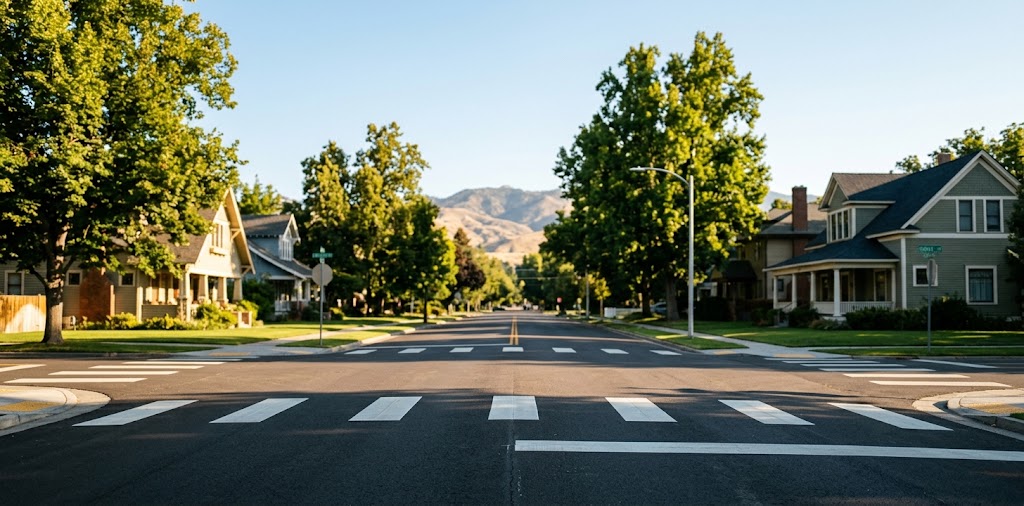
The last 5-0 vote ACHD will ever take this way
The five people who run the Ada County Highway District took a unanimous vote last Wednesday, August 26 — and it's the last budget they'll pass under the rules that got them elected. Five for, none against. That's the kind of tally a nonpartisan, district-based board tends to hand you. Patricia Nilsson, Alexis Pickering, Miranda Gold, Kent Goldthorpe, and Dave McKinney each won a single geographic district, no party label anywhere near their names. Every piece of that is about to change.
Senate Bill 1356 is why. Governor Brad Little signed it April 10, 2026, as Session Law Chapter 333, and under a very long title it does one thing: starting in 2028, ACHD commission races go partisan and countywide. The 2026 cycle still runs the old way — same districts, no parties, hold onto that. Two years out, every voter in Ada County votes on all five seats, and every candidate carries a party right next to their name.
ACHD owns essentially every public road in the county outside the state highway system, so the argument goes: a voter who drives the whole county should get a say in the whole board — the same way we all already vote on every Ada County Commission seat. It matches how the bigger county board runs today. State Senator Lori Den Hartog was reported among the proponents, though the bill itself came out of the Senate State Affairs Committee, not any one member's desk.
The objection, reported from inside the district, is quieter. Countywide races cost real money, which turns commissioners into full-time fundraisers, and a party label drags state politics into decisions about crosswalks, signal timing, and which intersection gets fixed first. And this thing barely happened: the Senate passed it 19-16, one vote from dead. The House was looser at 47-20-3. Delivered to the Governor April 2, signed eight days later, phasing in through January 1, 2027.
If you vote in Ada County, 2026 is the ballot you already know. 2028 is a different animal. Ever fought over one specific intersection near your house? That call now belongs to someone elected countywide with a party beside their name. And if you've never once wondered who runs the roads — most of us haven't — this is the year the answer starts having a party. Miranda Gold framed the budget plainly: it lets staff keep "meeting the needs of the more than 400,000 residents we serve." The next board that says that sentence will have gotten there another way.
So: if you own property on a road ACHD maintains, which is nearly all of us, watch who lines up for 2028, because that's the first ballot with parties on it. If you just want the two-line version to text somebody — the roads board passed a big budget 5-0 last week, and in 2028 those five seats go partisan and countywide, decided by every voter in the county. Which seat's your district? Reply and I'll tell you which year it's up.
You can only pour these footings when the gas tanks are empty
A $2 million leak-liability insurance policy is now a permanent condition of building at 1301 E. Lake St. in McCall — carried continuously, not just during construction. The McCall Planning and Zoning Commission approved “The Hardy” on a 4-1 vote and attached that policy to the yes.
The developer is Lake Star Ventures, based here in Boise. The design that cleared P&Z is five separate three-story buildings — a revision from an earlier single-structure scheme — with ground-floor commercial fronting Lake Street and 4,900-square-foot townhomes above, oriented to Mill Street, with attached garages, rooftop decks, saunas and hot tubs. Maximum 35 feet, measured from the Lake Street elevation. On paper it's a clean lakefront project across from the Mile High Marina.
The problem sits underneath it. The building footprint sits right next to the marina's underground fuel tanks — the only on-water fueling on Payette Lake. And Payette Lake is McCall's municipal drinking water. That's the sentence that made this a hearing instead of a rubber stamp. Robert Lyons, quoted by BoiseDev on the risk, put the optimistic read plainly: “It's not like a whole tank is going to dump into the lake.” Dave Petty was reported as the lone dissenting vote.
So the conditions did the arguing. Beyond the $2 million policy, Lake Star agreed to build an underground concrete H-pile wall to shield the tanks from structural pressure, conforming to PEI 100 recommended practice. And it accepted a seasonal earthwork restriction: no foundational digging above the tanks unless the tanks are completely empty — which confines the heaviest work to roughly October 1 through late May. You can only pour the footings when the gas tanks are empty. Screenshot that one.
There's a second condition worth a civilian translation. The city required Lake Star to legally separate the ground-floor storefronts from the residential units — condominiumize them — so the commercial spaces can be sold independently instead of deeded to the townhomes above. In plain terms: a hedge against dead luxury frontage, the kind of empty street-level glass that resort towns collect. Boise capital bought a hard lot.
THE TRAILHEAD: Boise State was tied with the No. 2 team in the country with 7:51 to play at Autzen Stadium, and left Eugene down 34-27 and 0-1. One missed tackle in space is the whole distance between those two sentences.
For anyone who didn't watch: the Broncos led 17-14 at halftime. Oregon opened the second half on a 10-0 run to go up 24-17. The teams traded field goals and it sat 27-27. Then Dante Moore found Dakorien Moore for 62 yards, a touchdown, and the game. Moore finished with 378 passing yards and three scores. The Blue never answered.
Spencer Danielson refused to let anyone call it close in a good way. "My heart hurts," he said afterward. "Proud of how we battled, wasn't enough. There's no moral victories. We've got to be better." His read was specific and unflattering. Tackling efficiency improved. But the secondary gave up too much grass, and too many negative-yardage plays buried the offense in third-and-long. Broncos Nation wanted to argue "we belong" against "we lost." Danielson took the wind out of the first one before anyone else could raise it.
Memphis comes to Albertsons Stadium on September 12, an American Athletic Conference team that already beat Boise State once, 35-32 in 2023. In the expanded College Football Playoff, the highest-ranked Group of Five champion gets an automatic bid, which is why a seven-point loss to the No. 2 team carries any résumé value at all. But 0-2 is a whole different season than 1-1. Memphis has film that says it can do this.
Maddux Madsen won the job over Max Cutforth in fall camp, and he gets the ball again Saturday against a team that isn't ranked and won't feel sorry for anybody. The gap between a program in this conversation and one that just took a nice road trip is a tackle on the edge, a stop on third down.
The hot spring ate the castle from the inside
You know that outdoor pool with the big waterslide on Warm Springs Avenue? The one that closed for the season last month? Stand in that parking lot. You're standing on the footprint of the grandest building this town ever built and then lost. The Natatorium. Everybody called it the Nat.
It opened in May 1892, and it was a lot. Two six-story towers with keyhole arches, Moorish Revival, drawn up by an architect named John C. Paulsen. Inside sat a 125-foot swimming pool, a 40-foot artificial waterfall, a copper slide, a dining room, a tea room, a saloon, a gymnasium, dance floors, card rooms. The Boise Artesian Hot & Cold Water Company built it. C.W. Moore founded that company, and the whole thing ran $87,000, which is over $2.1 million now. All of it fed on water struck out of the ground near the old penitentiary, coming up about 98 degrees.
That 98-degree water made steam, and steam soaks wood, and the wooden roof trusses held the whole place up while they quietly rotted from the inside. Not fast. Forty-two years. Then in 1934 a windstorm came through, and as one witness told the Idaho Architecture Project's Natatorium entry, “one of those big beams fell down in the pool.” The city condemned it. It never reopened. Boise's most beautiful building was killed by the exact thing everyone loved it for.
The ending isn't a headstone, though. The geothermal line got cut off after the closure, then the city hooked it back up for the pool that sits there now. The 2026 season ran May 27 to August 9.
📍 1811 E. Warm Springs Ave., Boise 83712. The pool is shut until next May, so this one's a look-from-the-sidewalk stop. Walk Warm Springs Avenue east of downtown in the late afternoon, light's best heading east, and read the houses the same water made possible, block by block. In season the pool runs $4.50 youth, $6.50 adults, free for seniors 62 and up, $13.50 for a weekend family package. It's a better walk in September than in July.
The same hot water that ate the Nat is still coming up at about 98 degrees — heating the houses down Warm Springs Avenue while the pool over the ruins closes every August like clockwork.
That's the one you tell at dinner.
- ●Ada County rat abatement — who pays, and Ryan Davidson's proposed abatement district — Whether the Idaho State Department of Agriculture reporting form and heat map actually launch; whether Eagl… (watching since 9/1) · Δ 9/4: the September 2 all-cities meeting happened — Central District Health declined to support forming an abatement district, and the tentative plan moved to centralized sighting reports through the Idaho State Department of Agriculture.
- ●Adler Industrial and 31 acres of state endowment land near Micron — What came out of the September 2 hearing; the State Board of Land Commissioners vote September 15; the auct… (watching since 9/1) · Δ 9/3: 2026-09-03: the September 2 IDL public hearing date has passed with the outcome still unverified in our record. The Land Board vote remains calendared for September 15.
- ●Red Ridge Village — DF Development's 722-unit 'new city' on 2,250 acres near McCall — The Valley County Planning and Zoning work session September 24 on DF Development's outstanding information… (watching since 9/3) · Δ 9/3: opened
- ●LEAP Housing — McCall's $1-a-year downtown land lease for workforce apartments — Whether LEAP Housing submits architectural plans to McCall Planning and Zoning as the lease requires; wheth… (watching since 9/3) · Δ 9/3: opened
- ●June's — the Empire Theatre building at 619 W. Main gets a bar after 113 years of blueprints — A firm opening date inside 'early 2027'; City of Boise permits; hours, menu and prices; and what else lands… (watching since 9/3) · Δ 9/3: opened