- 01Orange bags collected through June 2027; Boise plans no replacement.
- 0227th and Fairview tower: all studios and one-bedrooms, opens 2034.
- 03Eagle chip family proposes private sports campus; P&Z heard it Aug. 17.
- 04Discovery Center takes Julia Davis paddle boats; boathouse gets a green goose makeover.
Today is about the gap between what a place says it's doing and what it actually did. A recycling program ends after eight years, and the part almost nobody knew is where the plastic really went. That's the honest shape of this issue: promises with an asterisk, and the asterisk turns out to be the story.
Civic & Policy carries the piece that touches the most driveways — five valley jurisdictions about to lose their one option for hard-to-recycle plastic, with nothing behind it. The Market reads a 16-story tower not by its height but by its bedrooms. The Bench watches a semiconductor family propose to sell a drive four cities already make. And Drive-By History closes on a pond, a gift, and a can of green paint.
Every one of these is a valley deciding what it will pay for and what it won't.
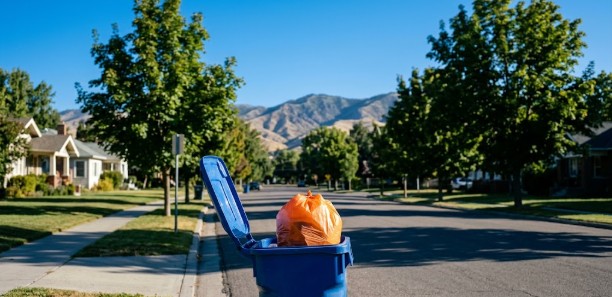
Eight years of orange bags, and where the plastic really went
Hefty pulled the plug on its orange bags Monday, August 24, and here's what changes for our Tuesday: if you live in Boise, Eagle, Garden City, Meridian or unincorporated Ada County, the ReNew program stops collecting those bags June 30, 2027. They leave store shelves at the end of 2026, as supplies last. After that, the candy wrappers, foam packaging, plastic wrap and salad bags we've been tucking into them go in the trash. Nampa, Caldwell and Kuna were never in it. And the city has already said it has nothing lined up to replace it — five jurisdictions with one option for hard-to-recycle plastic, about to have none.
Give the program its due first, because the number is real. Roughly 2,000 tons kept out of the local landfill since the 2018 launch. Public Works Director Steve Burgos called the end “disappointing,” and said it's “even more critical now that we remain mindful of what we are buying and how much waste we are creating.” Hefty's own reason, from its release, is that the recycling infrastructure “has not developed at the pace or scale anticipated.” On its face, that's a tidy story: good program, ran out of runway, everybody shakes hands.
Except for the part almost none of us in the valley ever heard. In 2021, Reuters reported that the program — then called Hefty EnergyBag, a Dow and Reynolds Consumer Products partnership — often trucked the material to cement plants to be burned for fuel, for lack of anywhere better to send it. The Salt Lake City processor, Renewlogy, told Reuters that Boise's stream showed up contaminated with other trash at ten times the level it had been told to expect. That reporting is five years old, and Reuters said “often,” not always. But it reframes the whole thing.
Because both facts hold at once. The 2,000 tons is a genuine diversion number, and “diverted from the landfill” sometimes turned out to mean burned somewhere else. This was never a conspiracy — it was on the record in 2021, and the warning signs were on the record before that. Back in 2019, a year and a half after the Boise launch, KTVB reported the bags were being held at a city recycling center rather than shipped to Utah while Renewlogy upgraded equipment. Once they did reach Utah, the contents were generally converted to diesel. The program was never quite the clean loop the blue-cart image promised.
So where does that leave the rest of us. The city's whole posture fits in one line from spokesperson Talia Miller, in an email to BoiseDev: “In the meantime, we encourage residents to reduce plastic waste where possible and choose reusable alternatives whenever they can.” Open to options, planning nothing. BoiseDev, whose Erin Banks Rusby has tracked this closely, noted the participating-communities page appeared to vanish from Hefty's website that same Monday. Got unused bags? Hefty will take them back with return-and-refund instructions. The real question lands on our counters next July, when the option is gone and the wrapper's still in our hand. Reply with one word — a real person reads every one.
713 apartments, 799 bedrooms, and not one family in mind
1.1 bedrooms per apartment. Do the division — 799 bedrooms across 713 units — and that thin number tells you who this building is for: people living alone or as a couple, and almost nobody else. That's what Urban Capital Partners filed for the vacant corner of 27th and Fairview, three buildings on a site it owns, topped by a 16-story tower that would stand among the tallest things on the western edge of downtown. Roughly 26,000 square feet of ground-floor retail comes with it. The height is the picture everyone will run, and the renderings are built to be run. The unit mix is the story.
Start with the arithmetic, because it doesn't flinch. Phase 1 is a seven-story, 185-unit building: 32 studios, 108 one-bedrooms, 45 two-bedrooms. Phase 2 runs seven stories and 330 units and tilts smaller still — 75 studios, 214 one-bedrooms, and just 41 two-bedrooms in the largest building of the three. The tower, Phase 3, holds 198 units — 50 studios and 148 one-bedrooms, and nothing after that. Not a single two-bedroom in 16 stories. There's a pool, a sports court and fire pits on Phase 1's third floor, and an amenity deck on the tower's fifth. There is no apartment up there where a kid gets their own room.
The backstory carries weight. Goodman Oil Company sat here from the 1920s to 2009, a former EPA brownfield that drew $730,000 in fines in 2009, per The Blue Review, and it's been a hole in the map for more than a decade since. Both this developer and the earlier one, Kal Pacific, trace to Don Veasy of Temecula, California. Kal Pacific's first version was 354 apartments plus an office building; UCP took over in 2024 and roughly doubled the count. As BoiseDev's Don Day reported, the project needs design review but is largely allowed by right, which means the public's leverage is the design, not the yes.
Read the parking and you read the intent. 717 vehicle spaces, 840 bicycle spaces across three garages. The bike count isn't virtue; it meets city code for the apartments and the retail, and that's worth saying plainly. Grant J. Seaman of Huraa Architecture wrote to the city that the plan “maintains and enhances the pedestrian connection to the Boise River Greenbelt,” with a new connection at the site's southwest corner. Per that same letter, ACHD approved a street change in May: Whitewater Park Boulevard extended across Fairview to Fletcher Street, in front of the shuttered Symposion bar. A former automotive service building on the corner comes down.
The calendar is where this stops being about a skyline. Infrastructure work starts Q4 2026. Building 1 breaks ground Q2 2027 and takes two years. Building 2 waits until mid-2029. The tower doesn't start until 2032 and, if the schedule holds, opens late 2034, four presidential elections out. Phase 1 alone runs $50 million to build, per an online offer memorandum, and Phase 3 could be built or sold off outright. This is a proposal in staff review, not an approval. But it's a specific answer to the housing question: supply for singles and couples, arriving slowly, on the western edge of downtown. Same median, different market. If you're the one who'd actually rent a studio here in 2034 — is 27th and Fairview where you want it, or is somebody building for the wrong Boise?
THE TRAILHEAD: A semiconductor company put your kid's drive to Meridian for court time into a zoning application and called it a market. If you play club volleyball in Eagle or travel baseball in Star, you know that drive — the 6 a.m. one, the one that eats a Saturday before anybody has warmed up. PSP Holdings wants to build the Premier Sports Pavilion on 6.3 acres along State Street near Horseshoe Bend Road in Eagle, east of the St. Luke's Eagle Medical Plaza. The pitch is one line: four cities produced the athletes and never built the places to put them. The permit letter says it in about that many words.
Start with what goes up. A 20,000-square-foot building on State Street holds a full-service fitness center, fitness studios, a physical therapy clinic, cold plunge spas, a sauna, locker rooms and showers. Inside that, per BoiseDev's reporting, sit four baseball training bays, two boxing simulation bays, six golf simulators with lounge seating and display screens, and a podcast and broadcast studio. There's a cafe with espresso, smoothies and acai, seating 40 to 50 inside and 40 more on a covered patio. Behind all of it, three synthetic turf fields and two hard courts sized for basketball, volleyball, futsal and whatever else a season demands.
That court complex sits under a steel canopy the application says is "engineered for the applicable wind, snow, and equipment suspension loads of the Eagle area." And the application names its market out loud, which almost never happens: Eagle, Star, Meridian and Boise. PSP writes that growth brought "an expanding population of youth athletes, recreational sports participants, fitness-oriented adults, and sports entertainment consumers who currently lack a comprehensive, high-quality facility in the immediate area." Translation for anyone not reading permit letters: somebody drove that drive one too many times and decided it was a business. The letter is unusually candid about the arithmetic underneath that decision.
Two numbers tell you what this place is. First, the owners: Louise and Victor Bertagnolli of Eagle, per Idaho Secretary of State records, who founded JST Manufacturing, a semiconductor company with operations in Meridian — the same city the drive ends in. That's not a sports company building a sports campus. That's a chip-manufacturing family, and it's a quiet note about where the valley's money sits and what it's buying now. Second, the parking. There are 216 vehicle spaces here, and two bicycle positions. Two. At a facility built on athletic health, you get there in a car, on Highway 44.
One more thing, and it is the one that matters. The gap PSP names is real: four fast-growing cities, not enough courts. But the thing filling it is private, membership-shaped, cold plunges and golf sims and a broadcast studio. This is what a parks department doesn't build. The project needs a conditional use permit and a rezone, the renderings are by KM Engineering, and it went to the Eagle Planning & Zoning Commission on August 17 — an outcome we couldn't confirm. So write it as proposed. But name it plainly: the valley grew the athletes, and the market's answer is a steel canopy you pay to get under. If you've driven the Star-to-Meridian court run at 6 a.m., tell me what you'd want under that canopy.
The oldest gift in Boise's parks now runs on green paint
You know that pond in Julia Davis Park, the one the paddle boats churn around all summer, sitting between the Discovery Center and the rose garden? You have probably pedaled it, or watched a kid pedal it while you held the snacks. It changed hands this year, quietly, and almost nobody noticed. There's a whole story in who owns those boats now, and it doesn't start with the boats at all. It starts 119 years ago, with a man whose wife died and who gave the city 43 acres because of it. The boats are the newest thing in the story by about a century.
Thomas Davis was an early Boise pioneer. The city says he may have known Abraham Lincoln back in Illinois in the 1840s — “may have,” so we'll leave it there. In 1907, Tom gave the City of Boise 43 acres as a memorial to his wife, Julia. He asked for nothing but her name on it. That's the oldest park the city has. The rose garden came later, dedicated in 1939, and it still carries around 2,400 roses a year. The geese came whenever geese decide to come. And the pond became the place generations of Boise kids learned that a paddle boat is mostly leg day.
Now the two transactions, side by side, because the distance between them is the whole story. Jayo Sports and Entertainment ran the paddle boats and the boathouse snacks for years, and in 2021 it agreed to keep operating through 2031. Then last year it terminated the license and walked away, six years early, and the city has not said why. The Discovery Center of Idaho, the science museum right there across the water, signed a new lease that started this year, took over the boats this summer, and pays $5,000 a year for the first five years. That lease runs through 2050. Twenty-four years, for a pond.
And the museum has plans for the building. It's filed an application to repaint the boathouse in its green brand colors. On the back wall, a silhouette of a paddle boat followed by a row of geese. On the wall facing the park, four words: “Paddle Like A Goose!” The old picnic tables on the deck would be swapped for matching resin-and-metal ones with umbrellas. So the oldest thing in Boise's park system — a widower's 43-acre gift — is getting handed to a science museum with a can of green paint, and honestly, the geese are the least surprising part.
📍 How to Visit — The pond sits inside Julia Davis Park, between the Discovery Center of Idaho and the main park along Capitol Boulevard downtown. The paddle boats are running right now, but BoiseDev reported the makeover is coming as “the paddle boat season winds down.” The boats come off before the paint goes on. So if you want to put a kid in a paddle boat before this pond turns green, that window is these next few weeks — not September, and the boats don't wait for your calendar. What you'll see next spring is a green boathouse with geese on it. That's the one you tell at dinner.
- ●BSU Pac-12 transition — September 12 home opener vs. Memphis - the helmet's debut and the building's official debut (watching since 6/23) · Δ 8/21: 2026-08-21: Boise State unveiled a one-of-a-kind 40th-anniversary helmet on August 19, hand-painted by artist Armando Villarreal with individually painted turf blades, an oversized 40 in the original 1986 font, seven hashmarks for each installation of The Blue, John Collias's 1986 retro logo and EST. 1986 on the back. It will be worn September 12 against Memphis - the home opener, the first Pac-12 home game, and the finished North End Zone's first real game. A limited quantity goes to Bronco Athletic Association members by priority ranking.
- ●Boise State 2026 QB1 & fall camp — Settled: camp closed Saturday, August 22 and Max Cutforth holds QB2 behind Maddux Madsen, with true freshma… (watching since 7/28) · Δ 8/21: 2026-08-21: fall camp closes Saturday, August 22 with no public resolution of the QB2 job behind Maddux Madsen. The September 5 opener at Oregon is two weeks out.
- ●The Village at Meridian Phase II — Eagle Road retail turnover — October 2026 Phase II ribbon-cutting; Salt & Straw build-out permit and opening; any Apple-confirmed openin… (watching since 7/31) · Δ 8/21: 2026-08-21: Apple's planned 10,000-square-foot Village store returned to national coverage on August 19 via MacRumors and downstream Apple outlets, all tracing to building permits BoiseDev first reported on April 24, 2026 and to BoiseDev's June 17 tenant roundup. The claim that Apple is targeting a September opening alongside the iPhone 18 Pro launch is attributed only to an unnamed tipster and is not confirmed by Apple or by permit records.
- ●Nampa FY2027 transit funding and the November police levy — FY2027 begins October 1 — that is when we find out what $283,193 actually buys in Nampa, including whether… (watching since 8/21) · Δ 8/21: opened
- ●Micron Research Labs - $10B Boise research campus — A Boise site announcement, a groundbreaking date, any Boise State or University of Idaho partnership, and t… (watching since 8/21) · Δ 8/21: opened
What did we miss this week? Reply to any issue — a real person reads every one, and the best reply runs right here next issue.